
NEET 2026 Syllabus [PDF Download]; Subject-wise Topics & Weightage
National Eligibility Cum Entrance Test 2026 ( NEET )

 Registration - 8 Feb '26 - 8 Mar '26


NEET Syllabus 2026: The NTA has released the NEET 2026 information bulletin containing the official syllabus for the exam. The syllabus is the same as notified by the NTA on January 8, 2026. The NEET 2026 syllabus has been finalised and published by the NMC. The NTA NEET syllabus 2026 is divided into three sections- Physics, Chemistry and Biology. The NEET Biology is further segregated into Botany and Zoology. Candidates can check here the syllabus for all three subjects to prepare for the exam. Also, check the latest NEET exam pattern 2026 below. It may be noted here that there is no change in the syllabus and pattern this year.
Candidates should prepare for the exam using the latest syllabus by making a study timetable covering each topic in detail. Get the final NEET syllabus 2026 PDF free download file below. Read the page further to know the chapter-wise weightage, important topics, exam pattern and deleted chapters. The NTA will conduct the NEET exam on May 3, 2026.
- NTA NEET Syllabus 2026: Overview
- Subject-Wise NEET 2026 Syllabus: Physics, Chemistry & Biology
- NEET Syllabus 2026: PDF Download
- NEET Chapter-Wise Weightage 2026
- Deleted Chapters in NEET 2026 Syllabus
- How to Prepare for NEET 2026?
- NEET 2026 Exam Pattern
- FAQs Regarding NEET 2026 Syllabus


NTA NEET Syllabus 2026: Overview
The NEET syllabus 2026 remains the same as that of last year. The NTA has not made any changes in the NEET new syllabus 2026. There are a total of 50 units spread across all three sections. The NEET Physics has 20 units, Chemistry has 20 units and Biology has 10 units. The NEET UG 2026 syllabus, finalised on December 22, 2025, based on Classes 11 & 12 NCERT curriculum is shared below.
| Physics |
Chemistry |
Biology |
|---|---|---|
| Physics & Measurement |
Physical Chemistry Basic Concepts of Chemistry |
Diversity in Living World |
| Kinematics |
Atomic Structure |
Structural Organisation in Animals and Plants |
| Laws of Motion |
Chemical Bonding, Molecular Structure |
Cell Structure and Function |
| Work, Energy & Power |
Chemical Thermodynamics |
Plant Physiology |
| Rotational Motion |
Solutions |
Human Physiology |
| Gravitation |
Equilibrium |
Reproduction |
| Properties of Solids and Liquids |
Redox Reactions and Electrochemistry |
Genetics and Evolution |
| Thermodynamics |
Chemical Kinetics |
Biology and Human Welfare |
| Kinetic Theory of Gases |
Inorganic Chemistry Classification of Elements and Periodicity in Properties |
Biotechnology and Its Applications |
| Oscillations and Waves |
p-Block Elements |
Ecology and Environment
|
| Electrostatics |
d- and f- f-Block Elements |
|
| Current Electricity |
Coordination Compounds |
|
| Magnetic Effects of Current & Magnetism |
Organic Chemistry Purification and Characterisation of Organic Compounds |
|
| Electromagnetic Inductions & Alternating Currents |
Some Basic Principles of Organic Chemistry |
|
| Electromagnetic Waves |
Hydrocarbons |
|
| Optics |
Organic Compounds Containing Halogens |
|
| Dual Nature of Matter and Radiation |
Organic Compounds Containing Oxygen |
|
| Atoms and Nuclei |
Organic Compounds Containing Nitrogen |
|
| Electronic Devices |
Biomolecules |
|
| Experimental Skills |
Principles Related to Practical Chemistry |
Also Read: Weightage of 11th and 12th in NEET 2026

Commonly asked questions
The NEET syllabus 2026 has been released by the NTA and NMC for Physics, Chemistry and Biology. Here is the syllabus for NEET UG 2026 exam below-
Physics | Chemistry | Biology |
|---|---|---|
Physics and Measurement | Some Basic Concepts of Chemistry | Diversity of Living Organisms |
Kinematics | Structure of Atom | Structural Organization in Plants & Animals |
Laws of Motion | Classification of Elements and Periodicity in Properties | Cell Structure and Function |
Work, Energy, and Power | Chemical Bonding and Molecular Structure | Plant Physiology |
Rotational Motion | States of Matter: Gases and Liquids | Human Physiology |
Gravitation | Thermodynamics | Reproduction |
Properties of Solids and Liquids | Equilibrium | Genetics & Evolution |
Thermodynamics | Redox Reactions | Biology and Human Welfare |
Kinetic Theory of Gases | Classification of Elements and Periodicity in Properties | Biotechnology and its Applications |
Oscillation and Waves | P-Block Elements | Ecology and Environment |
Electrostatics | D- and F-Block Elements |
|
Current Electricity | Coordination Compounds |
|
Magnetic Effects of Current and Magnetism | Purification and Characterisation of Organic Compounds |
|
Electromagnetic Induction and Alternating Currents | Some Basic Principles of Organic Chemistry |
|
Electromagnetic Waves | Hydrocarbons |
|
Optics | Organic Compounds Containing Halogens |
|
Dual Nature of Matter and Radiation | Organic Compounds Containing Oxygen |
|
Atoms and Nuclei | Organic Compounds Containing Nitrogen |
|
Electronic Devices | Biomolecules |
|
Experimental Skills | Principles Related to Practical Chemistry |
|
The NEET UG exam comprises Physics, Chemistry and Biology sections. There are a total 180 questions in the exam. The exam carries 720 marks. The section wise-wightage of these three sections is shared below-
NEET Physics- 45 questions (180 marks)
NEET Chemistry- 45 questions (180 marks)
NEET Biology (Botany & Zoology)- 90 questions (360 marks)
NEET syllabus is not tough, but a bit challenging due to its vastness. The syllabus of NEET exam is vast, with 20 chapters from Physics, 20 from Chemistry and 10 from Biology. The syllabus is based on the Class 11 and 12 NCERT curriculum. Hence, candidates should cover the complete syllabus to crack the exam.
Subject-Wise NEET 2026 Syllabus: Physics, Chemistry & Biology
The NTA NEET UG syllabus 2026 PDF contains subject-wise chapters and topics from which questions will be asked. There are a total of 50 chapters divided between Biology, Physics and Chemistry. Have a look at the subject-wise NEET 2026 syllabus below-
NEET Physics Syllabus 2026
There are 20 chapters or units in the NEET Physics syllabus. To perform better in this section, candidates should know all the NEET Physics formulas, laws and concepts. The detailed Physics syllabus for NEET 2026 is shared below.
| Unit Name | Topics Covered |
|---|---|
| Unit I: Physics and Measurement | Units of measurement; systems of units; SI units, fundamental and derived units. least count, significant figures, errors in measurement; Dimensions of physical quantities, dimensional analysis, and its applications. |
| Unit II: Kinematics | The frame of reference, motion in a straight line. Position- time graph. speed and velocity: Uniform and non-uniform motion. average speed and instantaneous velocity. Uniformly accelerated motion. velocity-time, position-time graph, relations for uniformly accelerated motion- Scalars and Vectors. Vector. Addition and subtraction, scalar and vector products. Unit Vector. Resolution of a Vector. Relative Velocity. Motion in a plane, Projectile Motion. Uniform Circular Motion. |
| Unit III: Laws of Motion | Force and inertia, Newton's First Law of Motion: Momentum, Newton’s Second Law of Motion, Impulses: Newton's Third Law of Motion. Law of conservation of linear momentum and its applications. Equilibrium of concurrent forces. Static and Kinetic friction, laws of friction. rolling friction. Dynamics of uniform circular motion: centripetal force and its applications: vehicle on a level circular road. vehicle on a banked road. |
| Unit IV: Work, Energy and Power | Work done by a constant force and a variable force; kinetic and potential energies. work-energy theorem, power. The potential energy of spring conservation of mechanical energy. conservative and non-conservative forces; motion in a vertical circle: Elastic and inelastic collisions in one and two dimensions. |
| Unit V: Rotational Motion | Centre of mass of a two-particle system, Centre of the mass of a rigid body: Basic concepts of rotational motion; moment of a force; torque, angular momentum, conservation of angular momentum and its applications. The moment of inertia, the radius of gyration, values of moments of inertia for simple geometrical objects, parallel and perpendicular axes theorems. and their applications. Equilibrium of rigid bodies. rigid body rotation and equations of rotational motion, comparison of linear and rotational motions. |
| Unit VI: Gravitation | The universal law of gravitation. Acceleration due to gravity and its variation with altitude and depth. Kepler's law of planetary motion. Gravitational potential energy; gravitational potential. Escape velocity, Motion of a satellite, orbital velocity, time period and energy of satellite. |
| Unit VII: Properties of Solids and Liquids | Elastic behaviour, Stress-strain relationship, Hooke's Law. Young's modulus, bulk modulus, modulus of rigidity. Pressure due to a fluid column; Pascal's law and its applications. Effect of gravity on fluid pressure. Viscosity. Stokes' law. terminal velocity, streamline, and turbulent flow. Critical velocity, Benoulli's principle and its applications. Surface energy and surface tension, angle of contact, excess of pressure across a curved surface, application of surface tension - drops, bubbles, and capillary rise. Heat, temperature, thermal expansion; specific heat capacity, calorimetry; change of state, latent heat. Heat transfer-conduction, convection, and radiation. |
| Unit VIII: Thermodynamics | Thermal equilibrium, zeroth law of thermodynamics, the concept of temperature. Heat, work, and internal energy. The first law of thermodynamics, isothermal and adiabatic processes. The second law of thermodynamics: reversible and irreversible processes. |
| Unit IX: Kinetic Theory of Gases | Equation of state of a perfect gas, work done on compressing a gas, Kinetic theory of gases - assumptions, the concept of pressure. Kinetic interpretation of temperature: RMS speed of gas molecules: Degrees of freedom. Law of equipartition of energy and applications to specific heat capacities of gases; Mean free path. Avogadro's number. |
| Unit X: Oscillations and Waves | Oscillations and periodic motion - time period, frequency, displacement as a function of time. Periodic functions. Simple harmonic motion (S.H.M.) and its equation; phase: oscillations of a spring -restoring force and force constant: energy in S.H.M. - Kinetic and potential energies; Simple pendulum - derivation of expression for its time period: Wave motion. Longitudinal and transverse waves, speed of travelling wave. Displacement relation for a progressive wave. Principle of superposition of waves, reflection of waves. Standing waves in strings and organ pipes, fundamental mode and harmonics- Beats. |
| Unit XI: Electrostatics | Electric charges: Conservation of charge. Coulomb's law forces between two point charges, forces between multiple charges: superposition principle and continuous charge distribution. Electric field: Electric field due to a point charge, Electric field lines. Electric dipole, Electric field due to a dipole. Torque on a dipole in a uniform electric field. Electric flux' Gauss's law, and its applications to find the field due to an infinitely long uniformly charged straight wire, uniformly charged infinite plane sheet, and uniformly charged thin spherical shell. Electric potential and its calculation for a point charge, electric dipole and system of charges; potential difference, Equipotential surfaces, Electrical potential energy of a system of two point charges and of electric dipole in an electrostatic field. conductors and insulators. Dielectrics and electric polarization, capacitors and capacitances, the combination of capacitors in series and parallel, capacitance of a parallel plate capacitor with and without dielectric medium between the plates. Energy stored in a capacitor. |
| Unit XII: Current Electricity | Electric current. Drift velocity, mobility and their relation with electric current. Ohm’s law. Electrical resistance. V-l characteristics of Ohmic and non-Ohmic conductors. Electrical energy and power. Electrical resistivity and conductivity. Series and parallel combinations of resistors; Temperature dependence of resistance. Internal resistance, potential difference and emf of a cell, a combination of cells in series and parallel. Kirchhoff’s laws and their applications. Wheatstone bridge. Metre Bridge. |
| Unit XIII: Magnetic Effects of Current and Magnetism | Biot-Savart law and its application to the current-carrying circular loop. Ampere’s law and its applications to infinitely long current carrying straight wire and solenoid. Force on a moving charge in uniform magnetic and electric fields. Force on a current-carrying conductor in a uniform magnetic field. The force between two parallel currents carrying conductors-definition of ampere. Torque experienced by a current loop in a uniform magnetic field: Moving coil galvanometer, its sensitivity, and conversion to ammeter and voltmeter. Current loop as a magnetic dipole and its magnetic dipole moment. Bar magnet as an equivalent solenoid. magnetic field lines; Magnetic field due to a magnetic dipole (bar magnet) along its axis and perpendicular to its axis. Torque on a magnetic dipole in a uniform magnetic field. Para dia and ferromagnetic substances with examples, effect of temperature on magnetic properties. |
| Unit XIV: Electromagnetic Induction And Alternating Currents | Electromagnetic induction: Faraday's law. Induced emf and current: Lenz’s Law, Eddy currents. Self and mutual inductance. Alternating currents, peak and RMS value of alternating current/voltage: reactance and impedance: LCR series circuit, resonance: power in AC circuits, wattless current. AC generator and transformer. |
| Unit XV: Electromagnetic Waves | Displacement current. Electromagnetic waves and their characteristics, Transverse nature of electromagnetic waves, Electromagnetic spectrum (radio waves, microwaves, infrared, visible, ultraviolet, X-rays, Gamma rays), Applications of e.m. waves. |
| Unit XVI: Optics | Reflection of light, spherical mirrors, mirror formula. Refraction of right at plane and spherical surfaces, thin lens formula and lens maker formula. Total internal reflection and its applications. Magnification. Power of a Lens. A combination of thin lenses in contact. Refraction of light through a prism. Microscope and Astronomical Telescope (reflecting and refracting) and their magnifying powers. Wave optics: wave front and Huygens' principle. Laws of reflection and refraction using Huygens principle. Interference, Young's double-slit experiment and expression for fringe width, coherent sources, and sustained interference of light. Diffraction due to a single slit, width of central maximum. Polarization, plane-polarized light: Brewster's law, uses of plane-polarized light and Polaroid. |
| Unit XVII: Dual Nature of Matter and Radiation | Dual nature of radiation. Photoelectric effect. Hertz and Lenard's observations; Einstein's photoelectric equation: particle nature of light. Matter waves-wave nature of particle, de Broglie relation. |
| Unit XVIII: Atoms and Nuclei | Alpha-particle scattering experiment; Rutherford's model of atom; Bohr model, energy levels, hydrogen spectrum. Composition and size of nucleus, atomic masses, Mass-energy relation, mass defect, binding energy per nucleon and its variation with mass number, nuclear fission, and fusion. |
| Unit XIX: Electronic Devices | Semiconductors; semiconductor diode: I-V characteristics in forward and reverse bias; diode as a rectifier; I-V characteristics of LED. The photodiode, solar cell, and Zener diode; Zener diode as a voltage regulator. Logic gates (OR. AND. NOT. NAND and NOR). |
| Unit XX: Experimental Skills | Familiarity with the basic approach and observations of the experiments and activities:
(i) Convex mirror (ii) Concave mirror, and (iii) Convex lens, using the parallax method.
|
Also Read:
NEET Chemistry Syllabus 2026
The Chemistry NEET is divided into three sections: Physical Chemistry, Organic Chemistry and Inorganic Chemistry. The NEET Chemistry chapter-wise topics are shared below.
Physical Chemistry Syllabus for NEET 2026
There are a total of eight units under the Physical Chemistry section. The unit-wise chapters and topics are given below.
| Unit Name | Topics Covered |
|---|---|
| Unit I: Some Basic Concepts of Chemistry | Matter and its nature, Dalton's atomic theory: Concept of atom, molecule, element. and compound. Laws of chemical combination; Atomic and molecular masses, mole concept, molar mass, percentage composition, empirical and molecular formulae: Chemical equations and stoichiometry. |
| Unit II: Atomic Structure | Nature of electromagnetic radiation, photoelectric effect; Spectrum of the hydrogen atom. Bohr model of a hydrogen atom - its postulates, derivation of the relations for the energy of the electron and radii of the different orbits, limitations of Bohr's model; Dual nature of matter, de Broglie's relationship. Heisenberg uncertainty principle. Elementary ideas of quantum mechanics, quantum mechanics, the quantum mechanical model of the atom, its important features. Concept of atomic orbitals as one-electron wave functions: Variation of Ψ and Ψ 2 with r for 1s and 2s orbitals: various quantum numbers (principal, angular momentum, and magnetic quantum numbers) and their significance; shapes of s, p, and d - orbitals, electron spin and spin quantum number: Rules for filling electrons in orbits - Aufbau principle. Pauli's exclusion principle and Hund's rule, electronic configuration of elements, extra stability of half-filled and completely filled orbitals. |
| Unit III: Chemical Bonding, Molecular Structure | Kossel-Lewis approach to chemical bond formation, the concept of ionic and covalent bonds. Ionic Bonding: Formation of ionic bonds, factors affecting the formation of ionic bonds; calculation of lattice enthalpy. Covalent Bonding: Concept of electronegativity. Fajan's rule, dipole moment: Valence Shell Electron Pair Repulsion (VSEPR) theory and shapes of simple molecules. |
| Unit IV: Chemical Thermodynamics | Fundamentals of thermodynamics: System and surroundings, extensive and intensive properties, state functions, types of processes. The first law of thermodynamics - Concept of work, heat internal energy and enthalpy, heat capacity, molar heat capacity; Hess's law of constant heat summation; Enthalpies of bond dissociation, combustion formation, atomization. sublimation. phase transition, hydration. ionization. and solution. The second law of thermodynamics - Spontaneity of processes: AS of the universe and AC of the system as criteria for spontaneity. Standard Gibbs energy change and equilibrium constant. |
| Unit V: Solutions | Different methods for expressing the concentration of solution - molality, molarity, mole fraction. percentage (by volume and mass both), the vapour pressure of solutions and Raoult's law - Ideal and. non-ideal solutions, vapour pressure - composition, plots for ideal and non-ideal solutions: colligative properties of dilute solutions - a relative lowering of vapour pressure, depression of freezing point, the elevation of.boiling point and osmotic pressure; Determination of molecular mass using colligative properties; Abnormal value of molar mass, Van't Hoff Factor and its significance. |
| Unit VI: Equilibrium | Meaning of equilibrium, the concept of dynamic equilibrium. Equilibria involving physical processes: Solid-liquid, liquid-gas, and solid-gas equilibria, Henry's law. General characteristics of equilibrium involving physical processes. Equilibrium involving chemical processes: Law of chemical equilibrium, equilibrium constants (Kp and Kc) and their significance, the significance of ΔG and ΔG° in chemical equilibrium, factors affecting equilibrium concentration, pressure, temperature, the effect of catalyst; Le Chatelier's principle. Ionic equilibrium: weak. and strong electrolytes, ionization of electrolytes, various concepts of acids and bases (Arrhenius and Bronsted - Lowry and Lewis) and their ionization, acid-base equilibria (including multistage ionization) and ionization constants, ionization of water. PH scale, common ion effect, hydrolysis of salts and PH of their solutions, the solubility of sparingly soluble salts and solubility products, buffer solutions. |
| Unit VII: Redox Reactions and Electrochemistry | Electronic concepts of oxidation-reduction, redox reactions, oxidation numbers, rules for assigning oxidation numbers, and balancing of redox reactions. Electrolytic and metallic conduction, conductance in electrolytic solutions, molar conductivities and their variation with concentration, Kohlrausch's law and its applications. Electrochemical Cells - Electrolytic and Galvanic cells, different types of electrodes, electrode potentials including standard electrode potential, half-cell and cell reactions, emf of a Galvanic cell and its measurement: Nernst equation and its applications; Relationship between cell potential and Gibbs' energy change: Dry cell and lead accumulator; Fuel cells. |
| Unit VIII: Chemical Kinetics | Rate of a chemical reaction, factors affecting the rate of reactions: concentration, temperature, pressure, 'and catalyst; elementary and complex reactions, order and molecularity of reactions, rate law, rate constants and its units, differential and integral forms of zero and first-order reactions, their characteristics and half lives, the effect of temperature on the rate of reactions, Arrhenius theory, activation energy and its calculation, collision theory of bimolecular gaseous reactions (no derivation). |
Inorganic Chemistry Syllabus for NEET 2026
There are four units in the Inorganic Chemistry section. Have a look-
| Unit Name | Topics Covered |
|---|---|
| Unit IX: Classification in Elements and Periodicity in Properties | Modern periodic law and present form of periodic table, s, p, d and f block elements, periodic trends in properties of elements, atomic and ionic radii, ionization enthalpy, electron gain enthalpy, valence, oxidation states, and chemical reactivity. |
| Unit X: P-Block Elements | Group 13 to Group 18 Elements General Introduction: Electronic configuration and general trends in physical and chemical properties of elements across the periods and down the groups; unique behaviour of the first element in each group. |
| Unit XI: d and f Block Elements | Transition Elements General introduction, electronic configuration, occurrence and characteristics, general trends in properties, of the first row transition elements - physical properties, ionization enthalpy, oxidation states, atomic radii, colour, catalytic behaviour, magnetic properties, complex formation, interstitial compounds, alloy formation; Preparation, properties and uses of K2Cr207 and KMn04. Inner Transition Elements Lanthanoids - Electronic configuration, oxidation states, and lanthanoid contraction. Actinoids - Electronic configuration and oxidation states. |
| Unit XII: Co-ordination Compounds | Introduction to coordination compounds.Wemer's theory: ligands, coordination number. denticity, chelation; IUPAC nomenclature of mononuclear coordination compounds, isomerism: Bonding-Valence bond approach and basic ideas of Crystal field theory, colour and magnetic properties; importance of co-ordination compounds (in qualitative analysis, extraction of metals and in biological systems). |
Organic Chemistry Syllabus for NEET 2026
This part has the highest number of units, which is eight. Let us take a look at the NEET Organic Chemistry topics.
| Unit Name | Topics Covered |
|---|---|
| Unit XIII: Purification and Characterisation of Organic Compounds | Purification - Crystallization. sublimation, distillation, differential extraction, chromatography - principles and their applications. Qualitative analysis - Detection of nitrogen, sulphur, phosphorus and halogens. Quantitative analysis (basic principles only) - Estimation of carbon. hydrogen. nitrogen. halogens. sulphur. phosphorus. Calculations of empirical formulae and molecular formulae: Numerical problems in organic quantitative analysis. |
| Unit XIV: Some Basic Principles of Organic Chemistry | Tetravalency of carbon: Shapes of simple molecules - hybridization (s and p): classification of organic compounds based on functional groups: and those containing halogens, oxygen, nitrogen and sulphur; Homologous series: Isomerism - structural and stereoisomerism. Nomenclature (Trivial and IUPAC) Covalent bond fission - Homolytic and heterolytic: free radicals. carbocations. and carbanions: stability of carbocations and free radicals. electrophiles. and nucleophiles. Electronic displacement in a covalent bond Inductive effect, electromeric effect. resonance and hyperconjugation. Common types of organic reactions- Substitution. addition. elimination, and rearrangement. |
| Unit XV: Hydrocarbons | Classification, isomerism. IUPAC nomenclature, general methods of preparation, properties, and reactions. Alkanes - Conformations: Sawhorse and Newman projections (of ethane): Mechanism of halogenation of alkanes, projections (of ethane). Alkenes - Geometrical isomerism: Mechanism of electrophilic addition: addition of hydrogen. halogens, water. hydrogen halides (Markownikoffs and peroxide effect): Ozonolysis and polymerization. Alkynes - Acidic character: Addition of hydrogen, halogens, water, and hydrogen halides: Polymerization. Aromatic hydrocarbons - Nomenclature. benzene - structure and aromaticity: Mechanism of substitution: halogenation, nitration. Friedel-Craft's alkylation and acylation, directive influence of the functional group in mono-substituted benzene. |
| Unit XVI: Organic Compounds Containing Halogen | General methods of preparation, properties, and reactions; Nature of C-X bond: Mechanisms of substitution reactions. Uses; Environmental effects of chloroform, iodoform freons, and DDT. |
| Unit XVII: Organic Compound Containing Oxygen | General methods of preparation, properties, reactions, and uses. Alcohols, Phenols and Ethers Alcohols: Identification of primary, secondary, and tertiary alcohols: mechanism of dehydration. Phenols: Acidic nature, electrophilic substitution reactions: halogenation. nitration and sulphonation. Reimer - Tiemann reaction. Ethers: Structure. Aldehyde and Ketones: Nature of carbonyl group; Nucleophilic addition to >C=O group, relative reactivities of aldehydes and ketones; Important reactions such as - Nucleophilic addition reactions (addition of HCN. NH3 and its derivatives), Grignard reagent; oxidation: reduction (Wolf Kishner and Clemmensen); the acidity of α-hydrogen. aldol condensation, Cannizzaro reaction. Haloform reaction, Chemical tests to distinguish between aldehydes and Ketones. Carboxylic Acids Acidic strength and factors affecting it. |
| Unit XVIII: Organic Compounds Containing Nitrogen | General methods of preparation. Properties, reactions, and uses. Amines: Nomenclature, classification structure, basic character, and identification of primary, secondary, and tertiary amines and their basic character. Diazonium Salts: Importance in Synthetic Organic Chemistry. |
| Unit XIX: Biomolecules | General introduction and importance of biomolecules. CARBOHYDRATES - classification; aldoses and ketoses: monosaccharides (glucose and fructose) and constituent monosaccharides of oligosaccharides (sucrose, lactose, and maltose) PROTEINS.Elementary Idea of α-amino acids, peptide bond, polypeptides.Proteins: primary. secondary, tertiary, and quaternary structure (qualitative idea only), denaturation of protein enzymes. VITAMINS - Classification and functions NUCLEIC ACIDS - Chemical constitution of DNA and RNA Biological functions of nucleic acids Hormones (General Introduction) |
| Unit XX: Principles Related to Practical Chemistry | Detection of extra elements (Nitrogen, sulphur, halogens), in organic compounds; Detection of the following functional group: hydroxyl (alcoholic and phenolic), carbonyl (aldehyde and ketones), carboxyl, and amino groups in organic compounds.
Inorganic compounds: Mohr's salt. potash alum Organic compounds: Acetanilide. p-nitro acetanilide, aniline yellow, iodoform
Cations Anions Chemical principles involved in the following experiments: 1. Enthalpy of solution of CuSO4 2. Enthalpy of neutralisation of strong acid and strong base 3. Preparation of lyophilic and lyophobic sols 4. Kinetic study of the reaction of iodide ions with hydrogen peroxide at room temperature. |
Also Read:
- NEET Chemistry Chapter-wise Weightage
- Physical Chemistry Chapters for NEET
- Inorganic Chemistry Chapters for NEET Preparation
Best books for NEET Chemistry
Some of the best books for NEET Chemistry preparation are as follows:
- 40 Days Chemistry for NEET by Sudhanshu Thakur
- Boyd for Organic Chemistry
- Concise Inorganic Chemistry by J D Lee
- Modern’s ABC of Chemistry (Part 1 & 2)
- Objective Chemistry (Volume I, II & III)
- Objective Chemistry by R K Gupta
- Organic Chemistry by Himanshu Pandey (GRB Publication)
- Organic Chemistry by Morrison
- Physical Chemistry by OP Tandon (G R Bathla Publications)
- Practice books
- Inorganic Chemistry – V K Jaiswal
- Organic Chemistry – M S Chauhan
- Physical Chemistry - N Awasthi
Also Read:
NEET Biology Syllabus 2026
Have a look at the major topics from the NEET Biology section and the chapter-wise distribution of topics below.
| Unit Name | Topics Covered |
|---|---|
| Unit I: Diversity in Living World | What is living?; Biodiversity; Need for classification; Taxonomy & Systematics; Concept of species and taxonomical hierarchy; Binomial nomenclature. Five kingdom classifications; salient features and classification of Monera; Protista and Fungi into major groups; Lichens; Viruses and Viroids. Also Read: Biological Classification NEET PYQ Salient features and classification of plants into major groups - Algae, Bryophytes, Pteridophytes, Gymnosperms (three to five salient and distinguishing features and at least two examples of each category). Also Read: Plant Kingdom NEET PYQ with Answers Salient features and classification of animals-nonchordate up to phyla level and chordate up to classes level (three to five salient features and at least two examples) Also Read: Animal Kingdom NEET PYQ Questions |
| Unit II: Structural Organisation in Animals and Plants | Morphology and modifications; Tissues; Anatomy and functions of different parts of flowering plants: Root, stem, leaf, inflorescence- cymose and recemose, flower, fruit and seed (To be dealt along with the relevant practical of the Practical). Family (malvaceae, Cruciferae, leguminoceae, compositae, graminae). Animal tissues; Morphology, anatomy and functions of different systems (digestive, circulatory, respiratory, nervous and reproductive) of an insect (frog). (Brief account only) |
| Unit III: Cell Structure and Function | Cell theory and cell as the basic unit of life; Structure of prokaryotic and eukaryotic cell; Plant cell and animal cell; Cell envelope, cell membrane, cell wall; Cell organelles-structure and function; Endomembrane system-endoplasmic reticulum, Golgi bodies, lysosomes, vacuoles; mitochondria, ribosomes, plastids, microbodies; Cytoskeleton, cilia, flagella, centrioles (ultra structure and function); Nucleus-nuclear membrane, chromatin, nucleolus. Chemical constituents of living cells: Biomolecules-structure and function of proteins, carbohydrates, lipids, nucleic acids; Enzymes-types, properties, enzyme action, classification and nomenclature of enzymes. B Cell division: Cell cycle, mitosis, meiosis and their significance. |
| Unit IV: Plant Physiology | Photosynthesis: Photosynthesis as a means of Autotrophic nutrition; Site of photosynthesis takes place; pigments involved in Photosynthesis (Elementary idea); Photochemical and biosynthetic phases of photosynthesis; Cyclic and non-cyclic and photophosphorylation; Chemiosmotic hypothesis; Photorespiration, C3 and C4 pathways; Factors affecting photosynthesis. Respiration: Exchange gases; Cellular respiration-glycolysis, fermentation (anaerobic), TCA cycle and electron transport system (aerobic); Energy relations- Number of ATP molecules generated; Amphibolic pathways; Respiratory quotient. Plant growth and development: Seed germination; Phases of Plant growth and plant growth rate; Conditions of growth; Differentiation, dedifferentiation and redifferentiation; Sequence of developmental process in a plant cell; Growth regulators- auxin, gibberellin, cytokinin, ethylene, ABA. |
| Unit V: Human Physiology | Breathing and Respiration: Respiratory organs in animals (recall only); Respiratory system in humans; Mechanism of breathing and its regulation in humans-Exchange of gases, transport of gases and regulation of respiration; Respiratory volumes; Disorders related to respiration-Asthma, Emphysema, Occupational respiratory disorders. Body fluids and circulation: Composition of blood, blood groups, coagulation of blood; Composition of lymph and its function; Human circulatory system-Structure of human heart and blood vessels; Cardiac cycle, cardiac output, ECG, Double circulation; Regulation of cardiac activity; Disorders of circulatory system-Hypertension, Coronary artery disease, Angina pectoris, Heart failure. Excretory products and their elimination: Modes of excretion- Ammonotelism, ureotelism, uricotelism; Human excretory system-structure and function; Urine formation, Osmoregulation; Regulation of kidney function-Renin-angiotensin, Atrial Natriuretic Factor, ADH and Diabetes insipidus; Role of other organs in excretion; Disorders; Uraemia, Renal failure, Renal calculi, Nephritis; Dialysis and artificial kidney. Locomotion and Movement: Types of movement- ciliary, flagellar, muscular; Skeletal muscle-contractile proteins and muscle contraction; Skeletal system and its functions (To be dealt with the relevant practical of Practical); Joints; Disorders of muscular and skeletal system-Myasthenia gravis, Tetany, Muscular dystrophy, Arthritis, Osteoporosis, Gout. Neural control and coordination: Neuron and nerves; Nervous system in human central nervous system, peripheral nervous system and visceral nervous system; Generation and conduction of nerve impulse; Reflex action; Sense organs; Elementary structure and function of eye and ear. Chemical coordination and regulation: Endocrine glands and hormones; Human endocrine system Hypothalamus, Pituitary, Pineal, Thyroid, Parathyroid, Adrenal, Pancreas, Gonads; Mechanism of hormone action (Elementary Idea); Role of hormones as messengers and regulators, Hypo-and hyperactivity and related disorders (Common disorders e.g. Dwarfism, Acromegaly, Cretinism, goiter, exopthalmic goiter, diabetes, Addison’s disease). (Imp: Diseases and disorders mentioned above to be dealt in brief.) |
| Unit VI: Reproduction | Sexual reproduction in flowering plants: Flower structure; Development of male and female gametophytes; Pollination-types, agencies and examples; Outbreeding devices; Pollen-Pistil interaction; Double fertilization; Post fertilization events- Development of endosperm and embryo, Development of seed and formation of fruit; Special modes-apomixis, parthenocarpy, polyembryony; Significance of seed and fruit formation. Human Reproduction: Male and female reproductive systems; Microscopic anatomy of testis and ovary; Gametogenesis-spermatogenesis & oogenesis; Menstrual cycle; Fertilisation, embryo development up to blastocyst formation, implantation; Pregnancy and placenta formation (Elementary idea); Parturition (Elementary idea); Lactation (Elementary idea). Reproductive health: Need for reproductive health and prevention of sexually transmitted diseases (STD); Birth control - Need and Methods, Contraception and Medical Termination of Pregnancy (MTP); Amniocentesis; Infertility and assisted reproductive technologies – IVF, ZIFT, GIFT (Elementary idea for general awareness) |
| Unit VII: Genetics and Evolution | Heredity and variation: Mendelian Inheritance; Deviations from Mendelism- Incomplete dominance, Co-dominance, Multiple alleles and Inheritance of blood groups, Pleiotropy; Elementary idea of polygenic inheritance; Chromosome theory of inheritance; Chromosomes and genes; Sex determination-In humans, birds, honey bee; Linkage and crossing over; Sex linked inheritance-Haemophilia, Colour blindness; Mendelian disorders in humans-Thalassemia; Chromosomal disorders in humans; Down’s syndrome, Turner’s and Klinefelter’s syndromes. Molecular basis of Inheritance: Search for genetic material and DNA as genetic material; Structure of DNA and RNA; DNA packaging; DNA replication; Central dogma; Transcription, genetic code, translation; Gene expression and regulation- Lac Operon; Genome and human genome project; DNA fingerprinting, protein biosynthesis. Evolution: Origin of life; Biological evolution and evidence for biological evolution from Palaeontology, comparative anatomy, embryology and molecular evidence.Darwin’s contribution, Modern Synthetic theory of Evolution; Mechanism of evolution-Variation (Mutation and Recombination) and Natural Selection with examples, types of natural selection; Gene flow and genetic drift; Hardy-Weinberg’s principle; Adaptive Radiation; Human evolution. |
| Unit VIII: Biology and Human Welfare | Health and Disease; Pathogens; parasites causing human diseases (Malaria, Filariasis, Ascariasis, Typhoid, Pneumonia, common cold, amoebiasis, ring worm); Basic concepts of immunology-vaccines; Cancer, HIV and AIDS; Adolescence, drug and alcohol abuse, Tobacco abuse. Improvement in food production; Plant breeding, tissue culture, single cell protein, Biofortification; Apiculture and Animal husbandry. Microbes in human welfare: In household food processing, industrial production, sewage treatment, energy generation and as biocontrol agents and biofertilizers. |
| Unit IX: Biotechnology and Its Applications | Principles and process of Biotechnology: Genetic engineering (Recombinant DNA technology). Application of Biotechnology in Health and Agriculture: Human insulin and vaccine production, gene therapy; Genetically modified organisms-Bt crops; Transgenic Animals; Biosafety issues- Biopiracy and patents. |
| Unit X: Ecology and Environment | Organisms and environment: Population interactions-mutualism, competition, predation, parasitism; Population attributes-growth, birth rate and death rate, age distribution. Ecosystem: Patterns, components; productivity and decomposition; Energy flow; Pyramids of number, biomass, energy. Biodiversity and its conservation: Concept of Biodiversity; Patterns of Biodiversity; Importance of Biodiversity; Loss of Biodiversity; Biodiversity conservation; Hotspots, endangered organisms, extinction, Red Data Book, biosphere reserves, National parks and sanctuaries, Sacred Groves. |
Also Read: NEET Biology Syllabus: PDF Download With Weightage
NEET Biology Topic-wise Questions
Analysing the topic-wise weightages of the Biology section, Shiksha is bringing topic-wise questions asked in the previous years' NEET question papers which they can practice from. Some of the important topics include Cell Cycle and Cell Division, Microbes in Human Welfare, Reproduction in Organisms, Human Reproduction, Biological Classification and Living World. Candidates can download the question paper PDFs from the table below.
Best books for NEET Biology
Some of the best books for NEET Biology preparation are shared below-
- 40 Days Biology for NEET by S Chakravarty
- Exploring Biology (Vol 1 & 2) by Sanjay Sharma & Sudhakar Banerjee (Arihant Publications)
- GR Bathla publications for Biology
- Medical Entrances Biology (Vol 1, 2 & 3) by Mamta R Solanki & Lalita Ghotik (Target Publications)
- Moderns ABC Plus of Biology for XI & XII (B B Arora and A K Sabharwal - Modern Publishers)
- Objective Biology (Vol 1, 2 & 3), Dinesh Publications
- Objective Botany by Ansari
- Pradeep’s A Textbook of Biology
- Trueman’s Objective Biology for NEET by M P Tyagi
Also Read:
Commonly asked questions
Candidates can get 700+ scores in NEET exam by preparing well in advance. Have a look at the NEET preparation tips to score high marks in the exam-
- Master the syllabus through NCERT books.
- Study the high-weigtage topics in detail.
- Practice the NEET mock test and sample papers.
- Solve last 5 years question papers of NEET UG.
- Revise regularly.
Candidates need to obtain the NEET exam pass marks to clear the exam. The minimum NEET cutoff percentile that candidates must obtain is shared below-
Category | NEET Cut off percentile |
|---|---|
UR/EWS | 50th |
OBC, SC, ST | 40th |
UR/EWS-PwD | 45th |
OBC/SC/St-PwD | 40th |
NEET exam can be a little tough for average students, given the competition and difficulty level. However, average students can crack the NEET UG exam with disciplined and consistent efforts. Such students should cover the syllabus and practice more and more question papers and NEET mock tests. Check here the NEET 2026 Preparation Plan for Average Students.
NEET Syllabus 2026: PDF Download
The NMC finalised the NEET UG 2026 syllabus on its website on December 22, 2025. The NMC syllabus for NEET 2026 is in line with Class 11 and Class 12 NCERT curriculum. Hence, it becomes convenient for Class 11 and 12 students to prepare simultaneously for the NEET exam along with their Board exams. The NTA released the same official syllabus as finalised by the NMC for NEET exam 2026 in January. Candidates who want to appear for the NEET UG 2026 exam should undertake serious preparations using the official PDFs shared below. The NMC & NTA NEET syllabus PDFs are shared below for free download.
| Download: |
Commonly asked questions
The NEET Chemistry syllabus is segragated into Organic, Inorganic and Physical Chemistry chapters. The units covered in these three areas are given below.
Physical Chemistry
Unit I: Some Basic Concepts of Chemistry
Unit II: Atomic Structure
Unit III: Chemical Bonding and Molecular Structure
Unit IV: Chemical Thermodynamics
Unit V: Solutions
Unit VI: Equilibrium
Unit VII: Redox Reactions and Electrochemistry
Unit VIII: Chemical Kinetics
Inorganic Chemistry
Unit IX: Classification in Elements and Periodicity in Properties
Unit X: p-Block Elements
Unit XI: d and f Block Elements
Unit XII: Coordination Compounds
Organic Chemistry
Unit XIII: Purification and Charactisation of Organic Compounds
Unit XIV: Some Basic Principles of Organic Chemistry
Unit XV: Hydrocarbons
Unit XVI: Organic Compounds Containing Halogens
Unit XVII: Organic Compounds Containing Nitrogen
Unit XIX: Biomolecules
Unit XX: Principles Related to Practical Chemistry
Also Read: NEET Chemistry Syllabus With Chapter-wise Weightage
Mechanics portion in class 11th is huge. The chapters are:
- Units of Measurement
- Laws of Motion
- Motion in straight line
- Motion in plane
- Work, Energy and Power
- System of Particles and Rotational Motion
- Rotational Dynamics
- Gravitation
- Mechanical properties of Solids and Fluids.
NEET Chapter-Wise Weightage 2026
There is no change in the NTA NEET UG syllabus 2026. Based on the comparison 2026 and 2025, it can be said that all the chapters remain the same. Hence, the NEET 2026 chapter-wise weightage remains the same as that of 2025. Have a look at the NEET chapter-wise weightage based on the NEET exam analysis by top experts below.
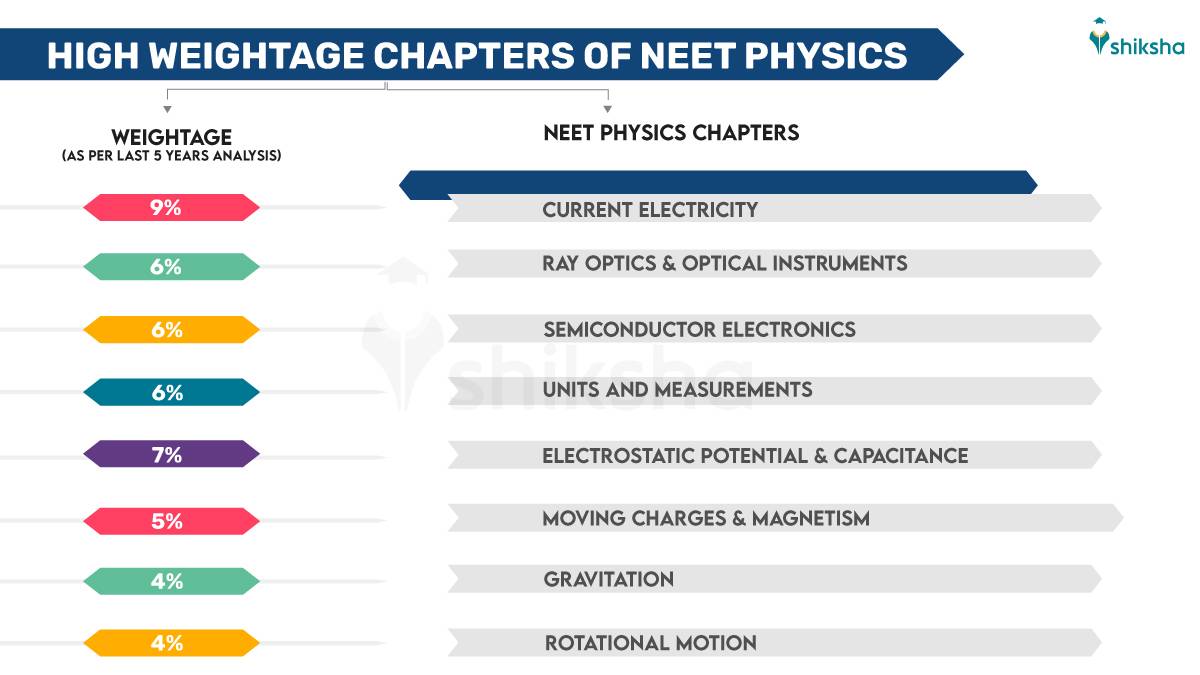
NEET Physics Chapter Wise Weightage
The table brings the NEET chapter-wise weightage for Physics.
| Physics Chapters and Topics |
Average Number of Questions from the Chapter |
Weightage of the chapter and topic |
|---|---|---|
| Measurement Error |
2 |
4% |
| Centre of Mass- Impulse |
1 |
2% |
| Work Power Energy- Work Energy Theorem |
1 |
2% |
| Simple Harmonic Motion- Spring Mass System |
2 |
4% |
| Rectilinear Motion- Velocity, Acceleration, Average Acceleration |
1 |
2% |
| Friction- Static Friction, Kinetic Friction |
1 |
2% |
| Relative Motion- Relative motion in one dimension |
1 |
2% |
| KTG and Thermodynamics Law of equipartition and internal energy Kinetic Theory of Gases |
2 1 |
4% 2% |
| Sound Wave- Organ pipes and resonance |
1 |
2% |
| Surface Tension- Excess Pressure in drops and bubble Capillar action |
1 1 |
2% 2% |
| Circular Motion Circular Motion in Horizontal plane Motion of a vehicle, Centrifugal force & rotation of earth |
1 1 |
2% 2% |
| Rigid Body Dynamics- Moment of Inertia |
1 |
2% |
| Modern Physics Bohr’s atomic model of H-atom and H-like species (properties) De–Broglie wave (Matterwaves) Photoelectric Effect |
1 2 1 |
2% 4% 2% |
| Electromagnetic waves |
2 |
4% |
| Electro Magnetic Field Magnetic field due to a circular loop Magnetic force and torque on a current carrying loop and magnetic dipole moment |
1 2 |
2% 4% |
| Electrostatics Dipole Properties of charge and Coulomb's Law |
1 1 |
2% 2% |
| Wave Optics- Polarisation | 2 |
4% |
| Current Electricity Combination of Resistance Battery, emf, terminal Voltage, KCL and KVL Definition of Current, Current Densities, Drift |
2 1 1 |
4% 2% 2% |
| Heat Transfer- Thermal conduction in linear conductors at steady state |
1 |
2% |
| Geometrical Optics Optical Instrument Combination of thin Lens/Lens and Mirrors |
1 1 |
2% 2% |
| Solid and Semiconductor Logic Gates Diodes |
1 1 |
2% 2% |
| Alternating Current- Power consumed in an AC Circuit |
1 |
2% |
| Gravitation- Kepler’s law for Satellites, Orbital speed and Escape speed Universal law of gravitation |
1 1 |
2% 2% |
| Capacitance- Capacitor with dielectric |
1 |
2% |
NEET Biology Chapter Wise Weightage: Botany and Zoology
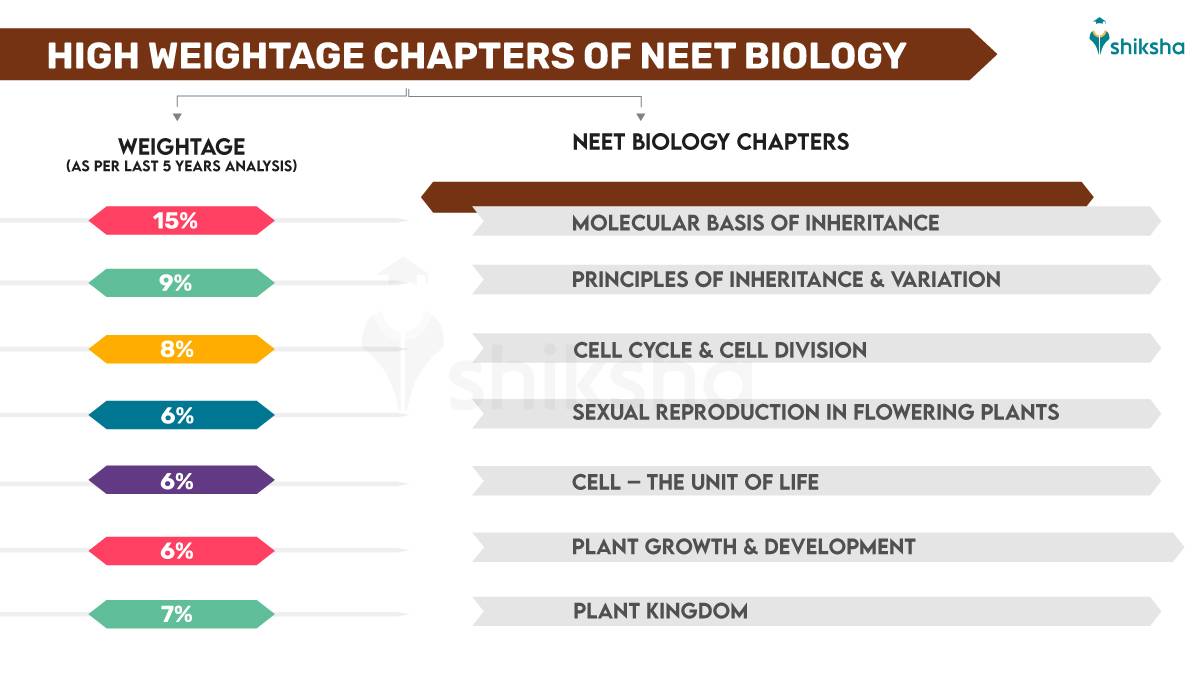
The Biology questions of NEET are divided into Botany and Zoology, each consisting of 45 questions. Let us take a look at the topics as per the NEET chapter-wise weightage for Biology.
| Biology Chapters and Topics |
Average No. of Questions from the Chapter |
Weightage of the Chapter and Topic |
|---|---|---|
| Botany |
48 |
96% |
| Plant Kingdom Kingdom plantae-GymNosperms Kingdom plantae-bryophytes Kingdom plantae-pteridophytes |
1 3 1 |
2% 6% 2% |
| Plant Physiology-II-Photosynthesis In Higher Plants Dark Reaction C3-cycle, C4 cycle, Photorespiration, CAM cycle and Factors Introduction (Early experiments), site of photosynthesis and photosynthetic pigments |
1 1 |
2% 2% |
| Cell Biology Cell Division Introduction, Procaryotic Cell Ribosome Cell membrane
|
1 2 1 2 |
2% 4% 2% 4% |
| Plant Physiology-II-Plant Growth and Growth Hormones |
2 |
4% |
| Morphology of Flowering Plants Flowers Seeds |
2 1 |
4% 2% |
| Plant Physiology-II-Respiration in plants Aerobic respiration- Link reaction and krebs cycle, Terminal oxidation, Respiratory balance sheet, Amphibolic pathway, Anaerobic respiration-Fermentation, Respiratory quotient |
1 |
2% |
| Anatomy of Flowering Plants- Anatomy of plant parts |
1 |
2% |
| Biological Classification- Kingdom-Monera |
1 |
2% |
| Ecology-Ecosystem- Productivity, Decomposition, Energy flow, Food chain, Food web, Ecological pyramids |
3 |
6% |
| Sexual Reproduction in Flowering Plants Fertilisation and embryogenesis, Seed and Polyembryony Pollination Female Reproductive Part Male Reproductive Part |
2 1 1 1 |
4% 2% 2% 2% |
| Genetics-II Regulation of gene expression, HGP and DNA fingerprinting Nucleic Acids (The Search For Genetic Material, DNA, RNA DNA Replication, Transcription, Genetic Code and Translation |
1 5 3 |
2% 10% 6% |
| Ecology-Organisms and Population Adaptations, Population and Population interactions, Biotic community Introduction, Abiotic factors, Responses to abiotic factors |
3 1 |
6% 2% |
| Genetics-I Polygenic Inheritance, Lethal Gene, Gene Interactions, Chromosomal Theory Of Inheritance, Sex Determination, Linkage, Sex Linkage, Recombination Mutation, Pedigree Analysis, Genetic Disorders Introduction, Mendelism, Monohybrid Cross, Dihybrid Cross, Back Cross, Test Cross, Incomplete Dominance, Codominance, Multiple Allelism, Pleiotropy |
2 1 1 |
4% 2% 2% |
| Ecology-Biodiversity and Conservation Conservation of biodiversity Introduction, Level of biodiversity, Pattern of biodiversity, Loss of biodiversity |
1 1 |
2% 2% |
| Zoology |
42 |
84% |
| Biomolecule-II- Enzymes |
3 |
6% |
| Chemical Coordination and Integration Adrenal gland Pituitary gland Hormone-secreting other organs |
2 1 1 |
4% 2% 2% |
| Animal Kingdom-2 Chordarta Amphibia Cyclostomata/Pisces |
1 4 1 |
2% 8% 2% |
| Animal Kingdom-1 Echinodermata Platyhelminthes and Aschelminthes |
1 1 |
2% 2% |
| Excretory Product and Their Elimination Urine formation Disease related with kidney |
1 1 |
2% 2% |
| Body fluids and circulation- Heart and conduction |
1 |
2% |
| Application Biology (Biotechnology) Principles of Biotechnology Applications of Biotechnology in Medicine, Transgenic Animals Processes of Biotechnology Applications of Biotechnology in Agriculture |
2 2 4 1 |
4% 4% 8% 2% |
| Biology In Human Welfare-Human Health and Disease Arthritis and Cancer Immune System and Common Human Diseases |
2 3 |
4% 6% |
| Human Reproduction and Reproductive Health Gametogenesis, Reproductive cycles Fertilisation, Embryonic, development Reproductive Health |
3 1 1 |
6% 2% 2% |
| Biology In Human Welfare-Microbes in Human Welfare- Microbes in Human Welfare |
4 |
8% |
| Origin and Evolution |
1 |
2% |
NEET Chemistry Chapter Wise Weightage 2026
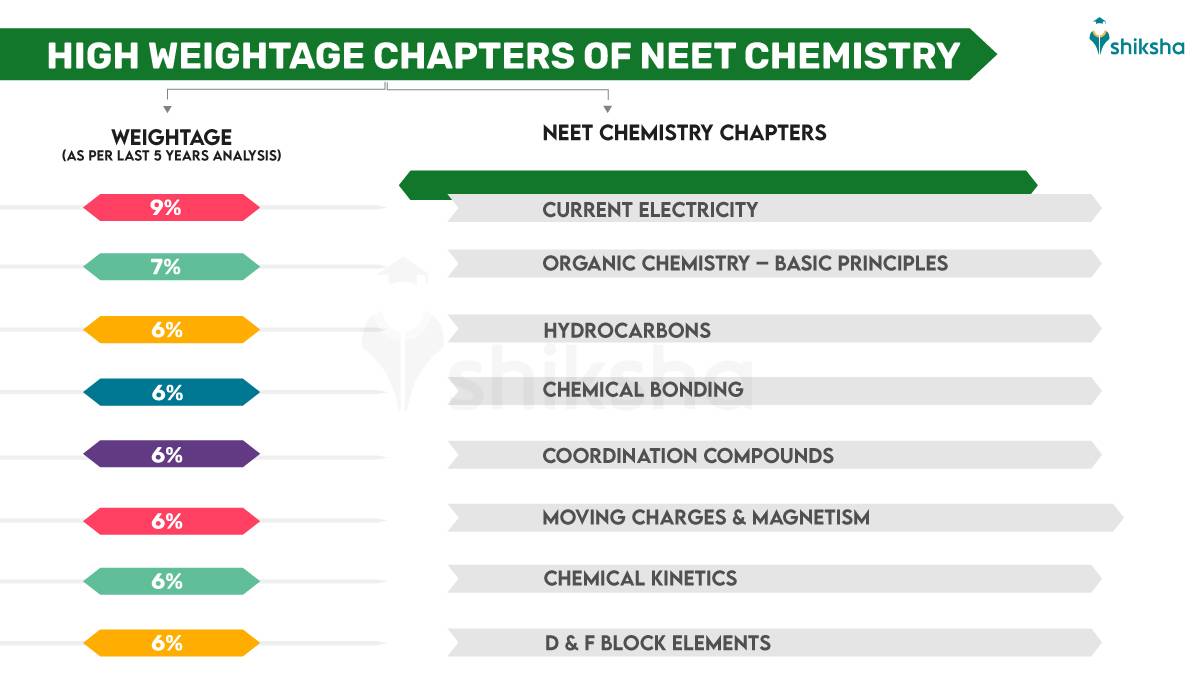
The NEET Chemistry section comprises Organic Chemistry, Inorganic Chemistry and Physical Chemistry. Know the Chemistry weightage for NEET in the below table.
| Chemistry Chapters and Topics |
Average No. of Questions from the Chapter |
Weightage of the Chapter and Topic |
|---|---|---|
| Physical Chemistry |
16 |
32% |
| Mole Concept Oxidation number Units, Atoms, Molecules, Atomic mass, Molecular mass, Gram atomic mass, Gram molecular mass, RAM, Average atomic mass
|
1 2 |
2% 4% |
| Thermodynamics- Enthalpy of Solution and Enthalpy of Neutralisation |
1 |
2% |
| Chemical Equilibrium KC and KP for Homogeneous Reaction Le-chatelier's principle |
1 1 |
2% 2% |
| Atomic Structure- Bohr's Model (Calculation of Radius, velocity and energy) |
2 |
4% |
| Ionic Equilibrium- pH Calculations: Weak Acid, Weak Base, Polyprotic acid |
1 |
2% |
| Chemical Kinetics The integrated rate laws, zero, first, nth order reaction Effect of Temperature, Arrhenius equation |
2 1 |
4% 2% |
| Solution Colligative Properties Colligative properties, Van't Hoff factor and its applications Solutions of Gases in Liquids (Henry’s law) Ideal and non-ideal solution, Azeotropes |
1 1 1 |
2% 2% 2% |
| Electrochemistry- Kohlrausch law and its applications |
1 |
2% |
| Inorganic Chemistry |
12 |
24% |
| Chemical Bonding Molecular Orbital Theory (MOT) Valence bond theory (VBT) and Hybridisation Hydrogen bonding |
1 1 1 |
2% 2% 2% |
| Periodic Table Electronegativity Development of Periodic Table, Period, Group and Block |
1 1 |
2% 2% |
| Coordination Compound Bonding in coordination compounds (Initial bonding theories and EAN rule, Valence bond theory) Crystal field theory and applications of crystal field theory : (Theory of Magnetic moment of complex, Colour of complex, Stability of complex) |
1 2
|
2% 4% |
| p-block (Nitrogen and Oxygen)- Physical and Chemical properties of Group 16th elements |
1 |
2% |
| d-f-Block Element Compound |
2 |
4% |
| Qualitative Analysis- Vth and VIth Group |
1 |
2% |
| Organic Chemistry |
17 |
34% |
| General Organic Chemistry Acidic strength Hyperconjugation effect Basic strength |
1 1 1 |
2% 2% 2% |
| Aromatic Compound |
1 |
2% |
| Grignard Reagent Practical Organic Chemistry Reduction Grignard Reagent |
2 1 1 |
4% 2% 2% |
| Reaction Mechanism Bimolecular nucleophilic substitution reaction of Alkyl Halide (SN2) Aryl Halide (SN2Ar) |
1 1 |
2% 2% |
| Aromatic Compound Aromaticity Electrophilic substitution Phenol |
1 1 1 |
2% 2% 2% |
| Stereoisomerism Specific rotation, observed rotation, optical purity and enantiomeric excess, Racemic mixture, Optical Resolution Geometrical isomerism |
2 1 |
4% 2% |
| Biomolecule and Polymer- Polymers Carbohydrate: Monosaccharide, Disaccharide, Polysaccharide |
1 1 |
2% 2% |
For more details, visit NEET 2026 Chapter-wise Weightage
Commonly asked questions
Candidates belonging to the General category should secure 50 percentile. Those belonging to the PwD General category has to secure 45 percentile. The NEET cutoff percentile for the reserved category candidates is 40. The exact qualifying marks or cutoff scores will be announced by NTA along with the scorecards. This year, General category candidates had to score minimum 137 marks to qualify for the exam.
The National Medical Commission (NMC) removed some topics from NEET syllabus in 2024. There are around nine chapters in Chemistry which have been removed. In Chemistry, these chapters or topics were removed from the units given in the table below.
Units | Topics |
|---|---|
Some Basic Concepts of Chemistry | General Introduction: Important and scope of chemistry. |
Atomic number, isotopes and isobars, Concept of shells and subshells, dual nature of matter and light. | |
Important compounds of silicon and a few uses: silicon tetrachloride, silicones, silicates and zeolites, their uses. | |
Organic Compounds Containing Nitrogen | Cyanides and Isocyanides- will be mentioned at relevant places. |
Environmental Chemistry | Environmental pollution: Air, water and soil pollution, chemical reactions in atmosphere, smogs, major atmospheric pollutants; acid rain ozone and its reactions, effects of depletion of ozone layer, greenhouse effect and global warming-pollution due to industrial wastes; green chemistry as an alternative tool for reducing pollution, strategy for control of environmental pollution. |
Polymers | Classification- Natural and synthetic, methods of polymerization (addition and condensation), copolymerization. Some important polymers: natural and synthetic like polyesters, bakelite; rubber, Biodegradable and non-biodegradable polymers. |
Chemistry in Everyday Life | Chemicals in medicines- analgesics, tranquilizers, antiseptics, disinfectants, antimicrobials, antifertility drugs, antibiotics, antacids, antihistamines. |
Surface Chemistry | Adsorption-physisorption and chemisorption; factors affecting adsorption of gases on solids, |
Haloalkanes and Haloarenes | · Haloalkanes: Nomenclature, nature of C –X bond, physical and chemical properties, mechanism of substitution reactions. Optical rotation. · Haloarenes: Nature of C-X bond, substitution reactions (directive influence of halogen for · Uses and environmental effects of – dichloromethane, trichloromethane, tetrachloromethane, iodoform, freons, DDT.
|
Also Read:
NEET Chemistry Syllabus With Chapter-wise Weightage
Deleted Chapters in NEET 2026 Syllabus
No chapter has been deleted in 2026 NEET syllabus by the NMC or NTA. However, the NTA removed certain chapters in 2024 from each NEET subject- Physics, Chemistry and Biology. Have a look at the list of deleted chapters of NEET below.
Deleted Chapters of NEET Syllabus
Here we bring the list of chapters and topics removed from the NEET syllabus from Class 11 and 12.
List of Deleted Chapters and Topics from Class 11 NEET Physics Syllabus
Unit I- Physical-world and Measurement
- Physics- Scope and excitement; nature of physical laws; Physics, technology, and society.
- Need for measurement- Length, mass, and time measurements; accuracy and precision of measuring instruments.
Unit II- Kinematics
Elementary concepts of differentiation and integration for describing motion. Scalar and vector quantities- Position and displacement vectors, general vectors, general vectors and notation, equality of vectors, multiplication of vectors by a real number; addition and subtraction of vectors. Relative velocity.
Unit III- Laws of Motion
Lubrication (under the Equilibrium of Concurrent Forces chapter)
Unit V- Rotational Motion
Momentum conservation, and centre of mass motion.
Unit VI- Gravitation
Geostationary satellites.
Unit VII- Properties of Bulk Matter/Properties of Solids and Liquids
- Shear, Poisson’s ratio; elastic energy. Reynold’s number, Anomalous expansion. Specific heat capacity- Cp, Cv- calorimetry; change of state – latent heat. Qualitative ideas of Black Body Radiation, Wein’s displacement law, and Green House effect.
- Newton’s law of cooling and Stefan’s law.
Unit VIII- Thermodynamics
Heat engines and refrigerators.
Unit X- Oscillations and Waves
- Free, forced and damped oscillations (qualitative ideas only), resonance.
- Doppler effect
List of Deleted Chapters and Topics from Class 12 NEET Physics Syllabus
Here we bring the list of chapters and topics removed from the NEET Physics syllabus from Class 12.
Unit I- Electrostatics
Van de Graaff generator.
Unit II- Current Electricity
- The flow of electric charges in a metallic conductor, Carbon resistors, colour code for carbon resistors; Potentiometer-principle and applications to measure potential difference, and for comparing emf of two cells; measurement of internal resistance of a cell.
Unit III- Magnetic Effects of Current and Magnetism
Concept of magnetic field, Oersted’s experiment. Magnetic dipole moment of a revolving electron. bar magnet as an equivalent solenoid, magnetic field lines; Earth’s magnetic field and magnetic elements. Electromagnetic and factors affecting their strengths. Permanent magnets
Unit IV- Electromagnetic Induction and Alternating Currents
LC oscillations (qualitative treatment only),
Unit VI- Optics
- Reflection and refraction of plane waves at a plane surface using wavefronts.
- Scattering of light-blue colour of the sky and reddish appearance of the sun at sunrise and sunset.
- Optical instruments- Human eye, image formation and accommodation, correction of eye defects (myopia and hypermetropia) using lenses.
- Microscopes and astronomical telescopes (reflecting and refracting) and their magnifying powers.
Unit VII- Dual Nature of Matter and Radiation
Davisson-Germer experiment (experimental details should be omitted; only the conclusion should be explained).
Unit VIII- Atoms and Nuclei
Isotopes, isobars; isotones. Radioactivity- alpha, beta and gamma particles/ rays and their properties decay law.
Unit IX- Electronic Devices
Energy bands in solids (qualitative ideas only), conductors, insulators, Junction transistor, transistor action, characteristics of a transistor; transistor as an amplifier (common emitter configuration) and oscillator.
List of Chapters Removed in NEET Chemistry Syllabus
Here we bring the list of chapters removed from the NEET Chemistry from Class 11 and Class 12.
The chapters/topics denote the NEET deleted syllabus of Class 11.
Unit I- Some Basic Concepts of Chemistry
General Introduction- Important and scope of chemistry.
Unit II- Structure of Atom
Atomic number, isotopes and isobars, Concept of shells and subshells, dual nature of matter and light.
Unit V- States of Matter- Gases and Liquids
- Three states of matter, intermolecular interactions, types of bonding, melting and boiling points, role of gas laws of elucidating the concept of the molecule, Boyle’s law, Charle’s law, Gay Lussac’s law, Avogadro’s law, ideal behaviour of gases, empirical derivation of gas equation. Avogadro number, ideal gas equation. Kinetic energy and molecular speeds (elementary idea), deviation from ideal behaviour, liquefaction of gases, critical temperature.
- Liquid State- Vapour pressure, viscosity and surface tension (qualitative idea only, no mathematical derivations).
Unit IX- Hydrogen
Occurrence, isotopes, preparation, properties and uses of hydrogen; hydrides ionic, covalent and interstitial; physical and chemical properties of water, heavy water; hydrogen peroxide preparation, reactions, uses and structure.
Unit X- s-Block Elements (Alkali and Alkaline Earth Metals)
Group I and Group 2 elements-
• General introduction, electronic configuration, occurrence, anomalous properties of the first element of each group, diagonal relationship, trends in the variation of properties (such as ionization enthalpy, atomic and ionic radii), trends in chemical reactivity with oxygen, water, hydrogen and halogens; uses.
• Preparation and Properties of Some important Compounds-
• Sodium carbonate, sodium chloride, sodium hydroxide and sodium hydrogen carbonate, biological importance of sodium and potassium.
• Industrial use of lime and limestone, biological importance of Mg and Ca.
Unit XI- Some p-Block Elements
Important compounds of silicon and a few uses- silicon tetrachloride, silicones, silicates and zeolites, their uses.
UNIT XIII- Organic Compounds Containing Nitrogen
Cyanides and Isocyanides- will be mentioned at relevant places.
UNIT XIV- Environmental Chemistry
Environmental pollution- Air, water and soil pollution, chemical reactions in atmosphere, smogs, major atmospheric pollutants; acid rain ozone and its reactions, effects of depletion of the ozone layer, greenhouse effect and global warming-pollution due to industrial wastes; green chemistry as an alternative tool for reducing pollution, strategy for control of environmental pollution.
List of Chapters Deleted from NEET Class 12 Syllabus
The chapters/topics denote the NEET deleted syllabus of Class 12.
Unit I- Solid State
Classification of solids based on different binding forces; molecular, ionic covalent and metallic solids, amorphous and crystalline solids (elementary idea), unit cell in two-dimensional and three-dimensional lattices, calculation of density of unit cell, packing in solids, packing efficiency, voids, number of atoms per unit cell in a cubic unit cell, point defects, electrical and magnetic properties, Band theory of metals, conductors, semiconductors and insulators.
Unit V- Surface Chemistry
Adsorption-physisorption and chemisorption; factors affecting adsorption of gases on solids, catalysis homogeneous and heterogeneous, activity and selectivity- enzyme catalysis; colloidal state- distinction between true solutions, colloids and suspensions; lyophilic, lyophobic multimolecular and macromolecular colloids; properties of colloids; Tyndall effect, Brownian movement, electrophoresis, coagulation; emulsions- types of emulsions.
UNIT XV- Polymers
Classification- Natural and synthetic, methods of polymerization (addition and condensation), copolymerization. Some important polymers- natural and synthetic like polyesters, bakelite; rubber, Biodegradable and non-biodegradable polymers.
UNIT XVI- Chemistry in Everyday Life
• Chemicals in medicines- analgesics, tranquillizers, antiseptics, disinfectants, antimicrobials, antifertility drugs, antibiotics, antacids, antihistamines.
• Chemicals in food- preservatives, artificial sweetening agents, elementary idea of antioxidants.
• Cleansing agents- soaps and detergents, cleansing action.
List of Chapters Deleted from NEET Biology Syllabus
Here we bring the list of chapters which were removed from the NEET Biology from Class 11.
Unit I- Diversity in Living World
- What is Living- Three domains of life; Concept of species and taxonomical hierarchy; Tools for study of Taxonomy – Museums, Zoos, Herbaria, Botanical gardens.
- Angiosperms classification up to class, characteristic features and examples.
Unit II- Structural Organisation in Animals and Plants
Animal tissues; Morphology, anatomy and functions of different systems (digestive, circulatory, respiratory, nervous and reproductive) of an insect (Frog). (Brief account only)
Unit IV- Plant Physiology
- Transport in plants- Movement of water, gases and nutrients; Cell to cell transport-Diffusion, facilitated diffusion, active transport; Plant – water relations – Imbibition, water potential, osmosis, plasmolysis; Long distance transport of water – Absorption, apoplast, symplast, transpiration pull, root pressure and guttation; Transpiration-Opening and closing of stomata; Uptake and translocation of mineral nutrients-Transport of food, phloem transport, Mass flow hypothesis; Diffusion of gases (brief mention).
- Mineral nutrition- Essential minerals, macro and micronutrients and their role; Deficiency symptoms; Mineral toxicity; Elementary idea of Hydroponics as a method to study mineral nutrition; Nitrogen metabolism-Nitrogen cycle, biological nitrogen fixation.
-
Plant growth and development- Seed dormancy; Vernalisation; Photoperiodism.
Unit V- Human Physiology
- Digestion and absorption; Alimentary canal and digestive glands; Role of digestive enzymes and gastrointestinal hormones; Peristalsis, digestion, absorption and assimilation of proteins, carbohydrates and fats; Caloric value of proteins, carbohydrates and fats; Egestion; Nutritional and digestive disorders – PEM, indigestion, constipation, vomiting, jaundice, diarrhoea.
- Neural control and coordination- Reflex action; Sense organs; Elementary structure and function of eye and ear.
Here we bring the chapters and topics NEET deleted syllabus from Class 12 Biology.
Unit I- Reproduction
Reproduction in organisms- Reproduction, a characteristic feature of all organisms for continuation of species; Modes of reproduction – Asexual and sexual; Asexual reproduction; Modes-Binary fission, sporulation, budding, gemmule, fragmentation; vegetative propagation in plants.
Unit III- Biology and Human Welfare
Improvement in food production; Plant breeding, tissue culture, single cell protein, Biofortification; Apiculture and Animal husbandry.
Unit V- Ecology and Environment
Organisms and environment- Habitat and niche; Population and ecological adaptations
Ecosystem Patterns- Nutrient cycling (carbon and phosphorous); Ecological succession; Ecological Services fixation, pollination, oxygen release.
Environmental issues- Air pollution and its control; Water pollution and its control; Agrochemicals and their effects; Solid waste management; Radioactive waste management; Greenhouse effect and global warning; Ozone depletion; Deforestation; Any three case studies as success stories addressing environmental issues.
Addition of New Chapters in NEET Syllabus
Along with the reduction of the NEET syllabus, there are some chapters in each subject which were added in last years. Here, we bring the topics or chapters which have been added to the NEET syllabus .
List of New Chapters Added in NEET Physics Syllabus
Following are the topics and chapters added to the NEET Physics.
Unit II- Kinematics
Resolution of Vector
Unit VI- Gravitation
Motion of a satellite, time period and energy of a satellite
Unit VII- Properties of Bulk Matter/Properties of Solids and Liquids
Pressure due to a fluid column; Pascal's law and its applications. Effect of gravity on fluid pressure.
Unit IX- Behaviour of Perfect Gas and Kinetic Theory
RMS speed of gas molecules- Degrees of freedom. Avogadro's number.
Unit III- Magnetic Effects of Current and Magnetism
Effect of temperature on magnetic properties.
Unit VII- Dual Nature of Matter and Radiation
Dual nature of radiation.
Unit XX- Experimental Skills
Familiarity with the basic approach and observations of the experiments and activities-
1. Vemier callipers are used to measure the internal and external diameter and depth of a vessel.
2. Screw gauge-its use to determine the thickness diameter of a thin sheet/wire.
3. Simple pendulum-dissipation of energy by plotting a graph between the square of amplitude and time.
4. Metre Scale - the mass of a given object by the principle of moments.
5. Young's modulus of elasticity of the material of a metallic wire.
6. Surface tension of water by capillary rise and effect of detergents.
7. Co-efficient of Viscosity of a given viscous liquid by measuring the terminal velocity of a given spherical body.
8. Speed of sound in air at room temperature using a resonance tube.
9. Specific heat capacity of a given (i) solid and (ii) liquid by method of mixtures.
10. The resistivity of the material of a given wire using a metre bridge.
11. The resistance of a given wire using Ohm's law.
12. Resistance and figure of merit of a galvanometer by half deflection method.
13. The focal length of;
(i) Convex mirror
(ii) Concave mirror, and
(iii) Convex lens, using the parallax method.
14. The plot of the angle of deviation vs angle of incidence for a triangular prism.
15. Refractive index of a glass slab using a travelling microscope.
16. Characteristic curves of a p-n junction diode in forward and reverse bias.
17. Characteristic curves of a Zener diode and finding reverse breakdown voltage.
18. Identification of Diode. LED,. Resistor. A capacitor from a mixed collection of such item
List of New Chapters Added in NEET Chemistry
The following chapters have been added to the NEET Chemistry.
Unit II- Structure of Atom
Bohr model of a hydrogen atom - its postulates, derivation of the relations for the energy of the electron and radii of the different orbits, limitations of Bohr's model.
Unit IV- Chemical Bonding, Molecular
- Kossel-Lewis approach to chemical bond formation, the concept of ionic and covalent bonds.
- Elementary idea of metallic bonding.
- Fajan's rule.
Unit- Chemical Thermodynamics
Fundamentals of thermodynamics- System and surroundings, extensive and intensive properties' state functions, types of processes.
The first law of thermodynamics - Concept of work, heat internal energy and enthalpy, heat capacity, molar heat capacity; Hess's law of constant heat summation; Enthalpies of bond dissociation, combustion' formation, atomization. sublimation. phase transition, hydration. ionization. and solution.
The second raw of thermodynamics - Spontaneity of processes- AS of the universe and AC of the system as criteria for spontaneity. Standard Gibbs energy change and equilibrium constant.
Unit VII- Redox Reactions and Electrochemistry
Electrolytic and metallic conduction, conductance and their in electrolytic solutions, molar conductivities variation with concentration- Kohlrausch's law and its applications.
Electrochemical cells - Electrolytic and Galvanic cells, different types of electrodes, electrode potentials including standard electrode potential, half-cell and cell reactions, emf of a Galvanic Cell and its measurement- Nernst equation and its applications, Relationship between cell potential and Gibbs' energy change- Dry cell and lead accumulator, Fuel cells.
Unit IV- Chemical Kinetics
Pressure, collision theory of bimolecular gaseous reactions (no derivation).
Unit VIII- d and f Block Elements
Transition Elements
Unit XIII- Purification and Characterisation of Organic Compounds
Purification - Crystallization. sublimation, distillation, differential extraction, chromatography - principles and their applications.
Qualitative analysis - Detection of nitrogen, sulphur, phosphorus and halogens.
Quantitative analysis (basic principles only) - Estimation of carbon. hydrogen. nitrogen. halogens. sulphur. phosphorus.
Calculations of empirical formulae and molecular formulae- Numerical problems in organic quantitative analysis.
Unit XIII- Hydrocarbons
Classification of isomerism. IUPAC nomenclature, general methods of preparation, properties, and reactions.
Unit- Organic Compounds Containing Halogen
General methods of preparation, properties, and reactions; Nature of C-X bond- Mechanisms of substitution reactions.
Uses; Environmental effects of chloroform, iodoform freons, and DDT.
Unit- Principles Related to Practical Chemistry
Detection of extra elements (Nitrogen, sulphur, halogens), in organic compounds; Detection of the following functional group, hydroxyl (alcoholic and phenolic), carbonyl (aldehyde and ketones) carboxyl, and amino groups in organic compounds.
- The chemistry involved in the preparation of the following-
Inorganic compounds- Mohr's salt. potash alum
Organic compounds- Acetanilide. p-nitro acetanilide, aniline yellow, iodoform
- The chemistry involved in the titrimetric exercises - Acids. bases and the use of indicators. oxalic-acid vs KMnO4. Mohr's salt vs KMnO4
Chemical principles involved in the qualitative salt analysis
Cations
Anions
Chemical principles involved in the following experiments-
1. Enthalpy of solution of CuSO4
2. Enthalpy of neutralization of strong acid and strong base
3. Preparation of lyophilic and lyophobic sols
4. Kinetic study of the reaction of iodide ions with hydrogen peroxide at room temperature.
List of New Chapters Added in NEET Biology Syllabus
The following chapters have been added to NEET Biology.
Unit II- Structural Organisation in Animals and Plants
Family (malvaceae, Cruciferae, leguminoceae, compositae, graminae)'
Unit VII- Genetics and Evolution
Molecular basis of inheritance- Protein biosynthesis
Unit VIII- Biology and Human Welfare
Health and Disease- Pathogens; parasites causing human diseases (dengue, chikungunya), Tobacco abuse
Unit X- Ecology and Environment
Biodiversity and its conservation- Sacred Groves.
Commonly asked questions
The National Testing Agency added some topics to the NEET exam syllabus in 2024. The chapters added to the syllabus are a part of curriculum in several state boards- Maharashtra, Bihar, Jammu and Kashmir, Nagaland and Manipur.
The National Medical Commission (NMC) revised the NEET syllabus in 2024. In the Biology, chapters were removed in around six units. The table brings the list of chapters and topics along with the units, which were removed in the NEET syllabus.
Units | Chapters/Topics |
|---|---|
Structural Organisation in Animals and Plants | Animal tissues; Morphology, anatomy and functions of different systems (digestive, circulatory, respiratory, nervous and reproductive) of an insect (Frog). (Brief account only) |
Plant Physiology | · Transport in plants: Movement of water, gases and nutrients; Cell to cell transport-Diffusion, facilitated diffusion, active transport; Plant – water relations – Imbibition, water potential, osmosis, plasmolysis; Long distance transport of water – Absorption, apoplast, symplast, transpiration pull, root pressure and guttation; Transpiration-Opening and closing of stomata; Uptake and translocation of mineral nutrients-Transport of food, phloem transport, Mass flow hypothesis; Diffusion of gases (brief mention). · Mineral nutrition: Essential minerals, macro and micronutrients and their role; Deficiency symptoms; Mineral toxicity; Elementary idea of Hydroponics as a method to study mineral nutrition; Nitrogen metabolism-Nitrogen cycle, biological nitrogen fixation. |
Human Physiology | Digestion and absorption; Alimentary canal and digestive glands; Role of digestive enzymes and gastrointestinal hormones; Peristalsis, digestion, absorption and assimilation of proteins, carbohydrates and fats; Caloric value of proteins, carbohydrates and fats; Egestion; Nutritional and digestive disorders – PEM, indigestion, constipation, vomiting, jaundice, diarrhoea. |
Reproduction | Reproduction in organisms: Reproduction, a characteristic feature of all organisms for continuation of species; Modes of reproduction – Asexual and sexual; Asexual reproduction; Modes-Binary fission, sporulation, budding, gemmule, fragmentation; vegetative propagation in plants. |
Biology and Human Welfare | Improvement in food production; Plant breeding, tissue culture, single cell protein, Biofortification; Apiculture and Animal husbandry. |
Ecology and Environment | Organisms and environment: Habitat and niche; Population and ecological adaptations Ecosystem Patterns: Nutrient cycling (carbon and phosphorous); Ecological succession; Ecological Services fixation, pollination, oxygen release. Biodiversity and its conservation: Sacred Groves. Environmental issues: Air pollution and its control; Water pollution and its control; Agrochemicals and their effects; Solid waste management; Radioactive waste management; Greenhouse effect and global warning; Ozone depletion; Deforestation; Any three case studies as success stories addressing environmental issues. |
Also Read: NEET Biology Syllabus with Chapter-wise Weightage
How to Prepare for NEET 2026?
NEET preparation is a time-consuming affair, and it should be done with a systematic approach. The first and foremost step is to know the syllabus for NEET UG properly. The best part about the NEET syllabus 2026 is from the Class 11 and Class 12 syllabi, and students are already familiar with the key concepts. Have a look at the NEET preparation tips below-
- Be thorough with the concepts: Students should know the concepts of the important topics from the NEET subjects. They should ensure that there is no gap in their understanding. In case of any doubts or queries, they should approach their mentors or teachers. Suggesting on the strategy to complete the syllabus, Saurabh Kumar, Chief Academic Officer, Vidyamandir Classes, says, "Make sure that the complete syllabus is covered in the first three months, which includes portions from both Class 11 and 12. Since aspirants might be fresh with the Class 12 portion of the NEET, the initial time should concentrate on covering the Class 11 portion to rewind things. And most importantly, do not opt to study new topics/ concepts at the last moment."
- Strategy for subject-wise preparation: Candidates must cover all the topics. While doing so, candidates may note that even though the weightage of the NEET Biology is higher, it would not be tougher than Physics. On the other hand, the number of topics in Physics or Chemistry may be lower, but the difficulty level would be higher. Talking about this, Saurabh Kumar mentions, "Though the Biology portion (Zoology and Botany) may be a bit easier in comparison to Physics, which has a higher number of theoretical and numerical questions. Biology students need to focus and practice more in the Physics section."
- Refer to the best books: While there is no dearth of books to prepare for NEET 2026, students should be careful in selecting those. The factors that need to be kept in mind include language quality and reading experience, practice questions and solutions and edition. NCERT is the best and the most popular book to refer to for NEET 2026 preparation. Hence, they should first complete the NCERT books and after that, they should move on to other NEET books or study materials.
Also Read: NCERT Books for NEET Preparation
- Get enough practice: As they say, practice makes a man perfect. In order to test whether the preparation of a particular section of the NEET 2026 syllabus is complete or not, candidates should take NEET mock tests or solve practice papers regularly. After that, they should analyse their performance to know where they can improve further.
- Analyse strengths and weaknesses: Analysing one's strengths and weaknesses is very important as it helps the student understand where he/she is standing in comparison with other candidates. With less than a month to go for the exam, it is high time that they focus on their strengths and don't stress over their weak areas. However, before leaving out a topic completely, students should check its weightage and then decide.
- Revision: Regular revision is key to NEET preparation. After completing each chapter, prepare notes on the key points along with charts, tables or diagrams to make it easily comprehensible. Browse through the revision notes regularly to not lose touch with those topics even after completing the basic preparation.
Commonly asked questions
The time for NEET preparation varies on factors like capacity of individual, hours of study per day, etc. Students should keep aside minimum five to six months for the NEET UG exam preparation. Candidates must keep a month prior to the exam for revision.
Yes, NCERT books are sufficient to complete the NEET syllabus. A number of past years' NEET toppers have claimed that they referred only to NCERT books for preparation. NCERT textbooks act as the base to complete the syllabus and develop conceptual clarity and understanding of the topics and chapters. However, for practice purposes, students may refer to other books and resources as well. It is advised that while starting the NEET preparation, candidates refer to the NCERT books and move towards other books and advanced resources after that.
NTA officially releases the NEET syllabus in English. Candidates opting for the exam in Hindi or other regional languages can check their Class 11 and Class 12 syllabus attuned to the NEET syllabus, from their teachers or mentors and request them to provide them with the NEET syllabus PDF download in Hindi or other regional languages. Hindi medium students can refer to their Board exam syllabus and crosscheck the topics or chapters. Aspirants should also go through previous years' NEET Hindi question papers to understand the question types, topics and difficulty level.
NEET 2026 Exam Pattern
The structure of the NEET question papers remains the same as last year. According to the latest NEET exam pattern, the total number of questions are 180. The exam duration is 180 minutes or three hours. The table below brings the NEET question pattern or the exam structure.
| Subject |
Number of Questions |
Marks |
|---|---|---|
| Physics |
45 |
180 |
| Chemistry |
45 |
180 |
| Botany |
45 |
180 |
| Zoology |
45 |
180 |
| Total |
180 |
720 |
NEET 2026 Marking Scheme
The table below brings the marking scheme of NEET.
| Response Type |
Marks awarded |
|---|---|
| Correct answer |
+4 |
| Incorrect answer |
-1 |
| Question with more than one response |
-1 |
| Unanswered question |
0 |
Read More:
FAQs Regarding NEET 2026 Syllabus
Commonly asked questions
Candidates belonging to the General category should secure 50 percentile. Those belonging to the PwD General category has to secure 45 percentile. The NEET cutoff percentile for the reserved category candidates is 40. The exact qualifying marks or cutoff scores will be announced by NTA along with the scorecards. This year, General category candidates had to score minimum 137 marks to qualify for the exam.
Maths is not compulsory for NEET. You have numerical in Physics but you do not required Maths in Class 11 and Class 12 to solve those. If you studied Maths in class 10, then you can solve the numericals in Physics. Since NEET has Physics, Chemistry and Biology subjects, it would be advantageous for you if you are a PCB student. Moreover, in case a candidate has studied PCM and not Biology, even as an additional subject, then he/she will not be eligible to appear for NEET exam. Hence, Maths is not compulsory, rather not required for NEET. But having basic mathematical knowledge and skills would be an added advantage.
Have a look at the important chapters of the NEET 2026 Chemistry section below-
Chemistry |
Structure of Atom |
Elements and Periodicity in Properties |
Hydrocarbons |
Basic Concepts of Chemistry |
Organic Chemistry |
Equilibrium |
Biomolecules |
Coordination Compounds |
The p-Block Elements (XII) |
Solutions |
Aldehydes, Ketones and Carboxylic Acids |
Haloalkanes and Haloarenes |
Chemical Kinetics |
No, the topic or chapter on earthworm is not included in the NEET Biology syllabus. The NEET syllabus underwent changes wherein certain topics were removed and various topics have been added from other state Boards. In the NEET revised syllabus, there was no mention of the Earthworms topic. Under the unit of Structural Organisation in Animals and Plants, the topic of 'Nervous and reproductive of an insect and Frog.' Based on last year's syllabus, it is estimated that the insect is cockroach, along with frog. Hence, it can be estimated that the Earthworm topic will not be included in the NEET Biology syllabus as well.
The National Testing Agency (NTA), had clarified the reason behind changing the NEET 2024 syllabus. NTA stated, "Due to the COVID-19 scenario, various School Boards deleted portions of each subject's syllabus. The deleted portion is still not being taken back by these Boards. The deletions were not uniform across various boards. Hence, a number of requests were received by the NTA for the revision of the syllabus." Last year, before the NEET exam, several students and parents asked NTA to release the rationalised NEET syllabus. Since the syllabus of NEET was already released before the rationalisation took place,
NEET or National Eligibility cum Entrance Test is a paper-and-pencil-based test (PBT) of three hours or 180 minutes duration. There will be a total of 180 multiple-choice questions (MCQs), all of which will be compulsory to attempt. The syllabus of the exam consists of Physics, Chemistry and Biology subjects. The Biology subject is segregated between Zoology and Botany. On the other hand, the Chemistry subject is segregated into Organic, Inorganic and Physical Chemistry. Unlike last year, the subjects will not be divided into two sections.
According to the marking scheme, each correct question carries 4 marks, and there is a negative marking of 1 mark for each wrong answer. No marks will be awarded or deducted for unattempted questions. The following table brings the structure of the NEET exam.
| Sections | Number of Questions | Total Marks |
|---|---|---|
| Physics Section | 45 | 180 |
| Chemistry Section | 45 | 180 |
| Botany Section | 45 | 180 |
| Zoology Section | 45 | 180 |
The NMC has released the syllabus for NEET 2026 examination. The NMC NEET UG syllabus 2026 is published on the website of the National Medical Commission (NMC) - nmc.org.in. Candidates can download the NMC syllabus for NEET 2026 here - https://www.shiksha.com/medicine-health-sciences/neet-exam-syllabus
The chance of a NEET question coming out of syllabus is low. As per the previous years' analysis, the questions were within the NEET syllabus only and the topics or chapters were evenly distributed. In case candidates encounter any question which is out of the syllabus, they must report it to the invigilator. In case test-takers know the answer and is sure of the accuracy, then they can attempt the question. Otherwise, they should leave the question unattempted. If it is proved that the question is out of NEET 2024 syllabus, NTA would cancel the question and award full marks to the candidates.
The Chemistry section of NEET is divided into three sub-sections: Physical, Organic and Inorganic. The least number of questions are from Physical Chemistry. Inorganic and Organic Chemistry chapters have almost similar weightage. In terms of the ratio of Class 11 and Class 12 syllabus of NEET the latter has a higher weightage. The total number of questions asked from the Chemistry section will be 50, out of which 45 questions have to be attempted. The topics carrying high weightage in NEET based on last year's analysis are given in the table below.
| NEET Chemistry Topics | Number of Questions |
|---|---|
| Organic Chemistry | 18 |
| Inorganic Chemistry | 17 |
| Physical Chemistry | 15 |
The NEET Biology section is divided into Botany and Zoology. Have a look at the NEET Botany important topics below-
Botany |
|---|
Cell: The Unit of Life |
Morphology of Flowering Plants |
Plant Growth and Development |
Plant Kingdom |
Photosynthesis in Higher Plants |
Molecular Basis of Inheritance |
Organisms and Populations |
Ecosystem |
Sexual Reproduction in Flowering Plants |
Microbes in Human Welfare |
Inheritance and Variation |
The table below contains the NEET Zoology important topics-
Zoology |
|---|
Structural Organisation in Animals |
Animal Kingdom |
Biomolecules |
Chemical Coordination and Integration |
Biotechnology |
Human Reproduction |
Human Health and Disease |
The National Medical Commission (NMC) revised the NEET syllabus in 2024. In the Biology, chapters were removed in around six units. The table brings the list of chapters and topics along with the units, which were removed in the NEET syllabus.
Units | Chapters/Topics |
|---|---|
Structural Organisation in Animals and Plants | Animal tissues; Morphology, anatomy and functions of different systems (digestive, circulatory, respiratory, nervous and reproductive) of an insect (Frog). (Brief account only) |
Plant Physiology | · Transport in plants: Movement of water, gases and nutrients; Cell to cell transport-Diffusion, facilitated diffusion, active transport; Plant – water relations – Imbibition, water potential, osmosis, plasmolysis; Long distance transport of water – Absorption, apoplast, symplast, transpiration pull, root pressure and guttation; Transpiration-Opening and closing of stomata; Uptake and translocation of mineral nutrients-Transport of food, phloem transport, Mass flow hypothesis; Diffusion of gases (brief mention). · Mineral nutrition: Essential minerals, macro and micronutrients and their role; Deficiency symptoms; Mineral toxicity; Elementary idea of Hydroponics as a method to study mineral nutrition; Nitrogen metabolism-Nitrogen cycle, biological nitrogen fixation. |
Human Physiology | Digestion and absorption; Alimentary canal and digestive glands; Role of digestive enzymes and gastrointestinal hormones; Peristalsis, digestion, absorption and assimilation of proteins, carbohydrates and fats; Caloric value of proteins, carbohydrates and fats; Egestion; Nutritional and digestive disorders – PEM, indigestion, constipation, vomiting, jaundice, diarrhoea. |
Reproduction | Reproduction in organisms: Reproduction, a characteristic feature of all organisms for continuation of species; Modes of reproduction – Asexual and sexual; Asexual reproduction; Modes-Binary fission, sporulation, budding, gemmule, fragmentation; vegetative propagation in plants. |
Biology and Human Welfare | Improvement in food production; Plant breeding, tissue culture, single cell protein, Biofortification; Apiculture and Animal husbandry. |
Ecology and Environment | Organisms and environment: Habitat and niche; Population and ecological adaptations Ecosystem Patterns: Nutrient cycling (carbon and phosphorous); Ecological succession; Ecological Services fixation, pollination, oxygen release. Biodiversity and its conservation: Sacred Groves. Environmental issues: Air pollution and its control; Water pollution and its control; Agrochemicals and their effects; Solid waste management; Radioactive waste management; Greenhouse effect and global warning; Ozone depletion; Deforestation; Any three case studies as success stories addressing environmental issues. |
Also Read: NEET Biology Syllabus with Chapter-wise Weightage
The important chapters of the NEET Physics section are listed below-
Physics |
|---|
Laws of Motion |
Work, Energy and Power |
Motion in a Straight Line |
Rotational Motion |
Oscillations |
Units and Measurements |
Thermodynamics |
Gravitation |
Ray Optics and Optical Instruments |
Moving Charges and Magnetism |
Current Electricity |
Semiconductor Electronics |
Electromagnetic Waves |
Electrostatic Potential and Capacitance |
Wave Optics |
Atoms |
Dual Nature of Radiation and Matter |
The chapters carrying high weightage in the NEET Physics syllabus are as follows:
- Thermodynamcs
- Current Electricity
- Dual Nature of Radiation and Matter
- Electromagnetic Waves
- Semiconductor Electronics: Materials, Devices and Simple Circuits
The following table brings the chapter-wise weightage of NEET Physics syllabus based on previous year's analysis.
Name of the chapter | Number of questions asked (Approx.) | Weightage in percent |
|---|---|---|
Alternating current | 1 | 4 |
0-1 | 1.5 | |
Current electricity | 2 | 8 |
Dual Nature of Radiation and Matter | 2 | 6 |
Electric Charges and Fields | 1 | 4.5 |
Electromagnetic induction | 1 | 4 |
Electromagnetic waves | 1 | 5 |
Electrostatic Potential and Capacitance | 1 | 4.5 |
0-1 | 2 | |
Kinetic theory | 1 | 3 |
1 | 3 | |
Magnetism and Matter | 1 | 2.5 |
Mechanical Properties of Fluids | 0-1 | 2 |
Mechanical Properties of Solids | 0-1 | 2 |
Motion in a Plane | 0-1 | 1.5 |
Motion in a Straight Line | 0-1 | 1.5 |
Moving Charges and Magnetism | 1 | 2.5 |
Nuclei | 0-1 | 1.5 |
Oscillations | 0-1 | 1.5 |
Physical World, Units and Measurements | 0-1 | 2 |
Ray optics and optical instruments | 1 | 5 |
Semiconductor Electronics: Materials, Devices and Simple Circuits | 2 | 6 |
System of Particles and Rotational Motion | 1 | 5 |
Thermal Properties of Matter | 0-1 | 2 |
2 | 9 | |
Wave optics | 1 | 5 |
0-1 | 1.5 | |
Work, Energy and Power | 1 | 4 |
Total | 45 | 100 |
Also Read: NEET Physics Syllabus with Chapter-wise Weightage
Medicine & Health Sciences exams you must check out
Exams which are to be conducted soon

Apr '26
Explore subject-wise topics asked in NEET
Select your preferred subject
NEET Exam
Student Forum
 Anything you would want to ask experts?
Answered Yesterday
A qualifying NEET score is generally considered good for MBBS in Kyrgyzstan. Along with this, students must have scored at least 50% marks in their class 12th exams.
R
Contributor-Level 8
Answered Yesterday
One is enough
Keep one extra in another file
A
Beginner-Level 1
Answered 2 days ago
Below are the NEET UG last round Cutoff:
| Course | 2023 | 2024 | 2025 |
|---|---|---|---|
| MBBS - Bachelor of Medicine and Bachelor of Surgery | 181435 | 105591 | 380852 |
| MBBS - Bachelor of Medicine and Bachelor of Surgery | 235256 | 243106 | 450886 |
R
Contributor-Level 10
Answered 2 days ago
Candidates can download the NEET admit card as and when released by the NTA. The admit card download link will be published at neet.nta.nic.in. Moreover, the direct link will be shared here- NEET admit card.
P
Contributor-Level 6
Answered 2 days ago
Candidates can download the NEET admit card PDF using the process shared below-
- Visit the website- neet.nta.nic.in.
- Click on the admit card link.
- Enter the login details.
- Download the PDF.
- Take its printout.
S
Contributor-Level 6
Answered 2 days ago
Comparing the three years of cutoff data for Round 1, it is evident that Jawaharlal Nehru Medical College, DMIMS saw a drop in its closing ranks for MBBS admission.
For more details, refer to the table below:
| Course | 2024 | 2025 |
|---|---|---|
| MBBS - Bachelor of Medicine and Bachelor of Surgery | 105591 | 380852 |
| MBBS - Bachelor of Medicine and Bachelor of Surgery | 243106 | 450886 |
R
Contributor-Level 10
Answered 2 days ago
The NEET UG 2026 admit card has not been released yet. The NTA will release NEET admit card or hall ticket around April 29, 2026, that is, four days before the exam.
R
Contributor-Level 6
Answered 2 days ago
Candidates can get 700+ scores in NEET exam by preparing well in advance. Have a look at the NEET preparation tips to score high marks in the exam-
- Master the syllabus through NCERT books.
- Study the high-weigtage topics in detail.
- Practice the NEET mock test and sample papers.
- Solve last 5 years questio
U
Contributor-Level 6
Answered 2 days ago
NEET exam can be a little tough for average students, given the competition and difficulty level. However, average students can crack the NEET UG exam with disciplined and consistent efforts. Such students should cover the syllabus and practice more and more question papers and NEET mock tests. Chec
V
Contributor-Level 6
Answered 2 days ago
KCET exam is not compulsory for NEET UG exam. However, KCET registration or UGCET registration is mandatory for candidates who want to participate in the Karnataka NEET Counselling. Candidates need to clear the NEET exam and should be KCET/ UGCET registered to take admissions to medical/ dental/ AYU
V
Contributor-Level 6
2325 Institutes accepting NEET
Varanasi • Public
- ₹ 2.32 Lakh
- 66 months
- |
- Full Time
West Bengal University of Animal and Fishery Sciences
Kolkata • Public
 4.5
4.5- ₹ 18,000
- 66 months
- |
- Full Time
All India Institute of Medical Sciences, Delhi
Gautam Nagar, Delhi • Public
- ₹ 6,075
- 66 months
- |
- Full Time
Christian Medical College, Vellore
Vellore • Private
- ₹ 15,000
- 66 months
- |
- Full Time

What NEET score is required for MBBS in Kyrgyzstan?